Last updated
Why deterministic nesting matters when money is on the line
A bid is a promise, and a promise built on a number that changes every time you run it isn't a promise - it's a guess. StoneNest is deterministic: feed it the same unit DXFs, the same slab size, the same kerf, and the same rotation policy, and it produces the same layout and the same slab count every single time, on every machine, every day. Every layout that comes out is checked by an independent validator that refuses to export if it finds any overlap, any placement off the slab, or any kerf violation - so the count you bid is a count you can actually walk onto the shop floor and cut. Run the Ridgeline Flats job - 108 units, 3 unit types, 0.133″ kerf - ten times and you get 132 slabs at 81.6% yield ten times.
Random optimizers give you a different answer every time you ask
Some nesting tools lean on randomized or heuristic search - shuffle the pieces, try a layout, shuffle again, keep whatever looks best this run. That can produce a good-looking single result, but it also means the same job can come back with a different slab count depending on when you hit run, which machine you ran it on, or what order the files loaded in. That's fine for a one-off render. It's a real problem when the number feeding your bid is supposed to be a fixed cost, not a moving target. If your slab count can shift between two runs of the identical job, you don't actually know what the job costs - you know what it cost that time.
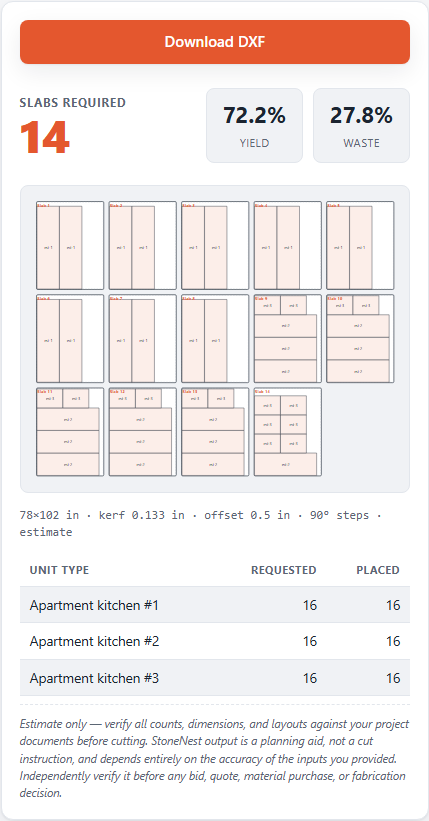
The same Ridgeline Flats job, re-nested: 132 slabs, 81.6% yield, identical to the first run.
Determinism is what makes a bid a bid
A bid is a commitment you're making before you've cut a single piece. The whole point of running the job through DXF-to-slab-count nesting before you quote is to replace a rough square-footage guess with a real number - but that only works if the real number holds still. StoneNest fixes the layout to the inputs: same unit DXFs, same slab dimensions, same 0.133″ kerf, same 0.50″ edge offset, same rotation policy (including Vein Flow aligned constraints where you've set them), same slab count and yield, run after run. Nothing about the outcome depends on when you clicked the button.
That repeatability is also what makes the independent validator meaningful. It isn't a suggestion layered on top of the nest - it's a hard gate that walks every layout and refuses to hand you an AlphaCAM-ready DXF export if it finds overlapping pieces, anything placed off the slab, or a kerf clearance violation. Combine a fixed, repeatable layout with a validator that can only say yes or no - never "close enough" - and you get a number you can defend to a customer and hand to a fabricator on the same afternoon.
What this looks like on a real job
On a job like Ridgeline Flats, a multifamily run of 108 units across 3 unit types, determinism isn't an abstract virtue - it's the difference between quoting once and re-quoting every time someone asks you to double-check the count. Nest it today, nest it again next month with the same inputs, and it still comes back 132 slabs at 81.6% yield, processed in batches of up to 6 slabs at a time, with as many as 18 unit types supported per job. See how the same logic scales across a whole property in the multifamily estimating guide, or check how yield itself is calculated in the slab yield guide. Everything runs on your own machine with a machine-bound license - nothing about your job data leaves your shop, and nothing about the result depends on a server having a good day.
If you want to see it hold still on your own files, run it yourself: try StoneNest free for 7 days, no card required. When you're ready to license a seat, pricing starts at $69/mo for the first 25 early-adopter seats, locked for the life of the subscription, then $99/mo - with a 30-day refund on your first paid month if it doesn't hold up on your jobs.
FAQ
What does "deterministic nesting" mean?
It means the same inputs - the same unit DXFs, slab size, kerf, edge offset, and rotation policy - always produce the same layout and the same slab count, on any machine, every time you run the job. Nothing about the result depends on randomness or run order.
Why does this matter for bidding?
A bid is a fixed number you commit to before cutting starts. If re-running the same job could return a different slab count, the number behind your bid isn't stable, which means your margin isn't stable either. Deterministic nesting keeps the count fixed to the inputs, not to chance.
How does the validator relate to determinism?
The validator checks every layout for overlaps, off-slab placement, and kerf violations before it will allow an export. Because the underlying nest is deterministic, a layout that passes validation once will pass it again on the next identical run - there's no risk of a passing layout quietly becoming invalid.
Does determinism mean the layout can't change at all?
It changes only when an input changes - a different unit count, a different slab size, a different kerf, a different rotation policy. Change nothing, and the layout and slab count stay identical. That predictability is what lets you re-quote part of a job without re-nesting the whole thing from scratch.
Related guides
How Layouts Are Validated
The second-opinion gate that blocks bad exports.
ComparisonNesting Software Comparison
A plain, side-by-side look at four real nesting options — what each one costs, what it actually does, and why the bidding-and-cutting slice of the job is the one StoneNest was built to own.
WorkflowFrom DXF to Slab Count
The mechanical path from the DXF your ERP or CAD already exports to a validated slab count and cut-ready file.
See what your own job nests to
Try the free web estimator with your own unit counts, or start the 7-day free trial for full DXF import, export, and the validator gate.